
Zachary A. Tingley
In 1835, A. C. Buchanan, the crown’s agent for emigration in Upper and Lower Canada, sent a letter to Lord Aylmer, Governor of British North America, on the subject of possible improvements that could be made for vessels navigating the Gulf of St. Lawrence. In his opening remarks, Buchanan wrote “I have the honor to submit to your Excellency the accompanying Chart, illustrative of my plan for rendering more safe the Navigation of the Gulf and River St. Lawrence, to which I alluded in my general Emigration Report of last year that I had the honor to lay before your Lordship.”[1] Buchanan goes on to express his concern for the wellbeing of the “many thousands of Emigrants” destined for the Canadas and indicated that he had as a “consequence been prompted to devote much thought to the subject.”[2] In submitting his evaluation of navigation in the Gulf and proposed solutions to various challenges therein, Buchanan’s thoughts about that space elicited a strong emotional response, and in his view, required immediate action on part of the Imperial government. The drawing up and submission of Buchanan’s solutions in the form of a nautical chart and corresponding letter provides an important window into how this vast space roused one’s emotions and was imagined by those in positions of authority in a desperate search to for solutions that would improve navigational safety in the Gulf and safeguard human life while sailing in the region.[3] Buchanan’s chart and letter shed light on how hazards were felt, imagined, and responded to, and how the localized dangers in a specific marine space resonated through local British settler communities around the Gulf, and across the Atlantic Ocean.
The drawing up and submission of Buchanan’s solutions in the form of a nautical chart and corresponding letter provides an important window into how this vast space roused one’s emotions and was imagined by those in positions of authority in a desperate search to for solutions that would improve navigational safety in the Gulf and safeguard human life while sailing in the region.
Over the course of his career as emigration agent, Buchanan witnessed first-hand the movement of large numbers of settlers into British North America, and was aware of the associated settler-colonial violence associated with large numbers of peoples from the British Isles coming to settle the areas that he was responsible for administering. This movement of people was not limited to the terrestrial space, and between 1820 and 1839 all settlers who arrived in the Canadas, Prince Edward Island, and the Gulf coasts of New Brunswick and Nova Scotia traveled on board vessels which transited the potentially treacherous waters of the Gulf of St. Lawrence. While Buchanan was professionally responsible for overseeing those who arrived on land, his letter indicates a deep concern over the frequent loss of life on, and in, the waters of the Gulf.

Given Buchanan’s role as emigration agent, it is perhaps surprising that the proposed solutions such as the anchoring of a constantly manned lightship between Cape Breton and Newfoundland were simply untenable because of constraints posed by non-human nature such as storms, wave action, and currents. Yet at the same time, Buchanan recognized the significance and importance of the circumstances mariners and potential settlers faced as they traveled across the Gulf and along the St. Lawrence River. In devising his solution to keep mariners and their passengers safe, Buchanan imagined a Gulf that included fixed jurisdictional lines; consequently the recommendations that he put forth operated within those seemingly rigid frameworks of established settler-colonial boundaries. For his part Buchanan advocated for the establishment of a lighthouse on St. Paul’s Island, a “Floating Light [lightship] be stationed on the Western End of the Green Bank, in about 35 fathoms depth of water,” and the construction of a lighthouse at Bird Island.[4] The lightship, its operation, as well as seasonal installation and removal were to be entrusted to the “authorities at Halifax,” and the responsibility for the operation and maintenance of a lighthouse on Bird Island was to belong to the Government of New Brunswick.[5] While no mention of who might be responsible for the operation of the proposed lighthouse at St. Paul’s Island was noted in Buchanan’s letter it is clear that recommendations for solutions which fell outside of his own jurisdictional purview were, in Buchanan’s view, necessary for saving lives in the Gulf as he was “prepared to expect that the objections I advance against a Light House on the Island of St. Paul’s, may on first view not find that advocacy that I anticipate will ere long be given to it.”[6] Buchanan understood that others who came to be familiar with the severity of the loss of human life in the Gulf would be driven by their own emotions to advocate for solutions to the challenges of safe navigation of the Gulf.
Between 1820 and 1830 roughly 100,000 British Subjects migrated to the Canadas, New Brunswick, Nova Scotia, and Prince Edward Island, some in search of new opportunities, and others fleeing from the plight of famine and social injustice. Between 1830 and 1840, specifically, the number of people choosing to settle increased from about 10,000 people a year over the course of the previous decade to over 50,000 people annually.[7] This steady increase in settlers, and the mariners who moved them, also coincided with a steady increase in trade, and exploitation of the region’s fisheries to feed a growing population at home and abroad. For Buchanan the role of the emigrants’ transit across the Gulf and up the St. Lawrence River was felt and imagined in ways that shifted in step with a growing number of new arrivals because the steady increase in vessels sailing on the Gulf exponentially increased the risk for shipwreck and loss of life. Buchanan’s angst about the safety of people at sea was something that he held in common with other colonial and state officials. Buchanan’s voice became one of many which contributed to a growing moral economy anchored on navigational safety in the Gulf of St. Lawrence.[8]
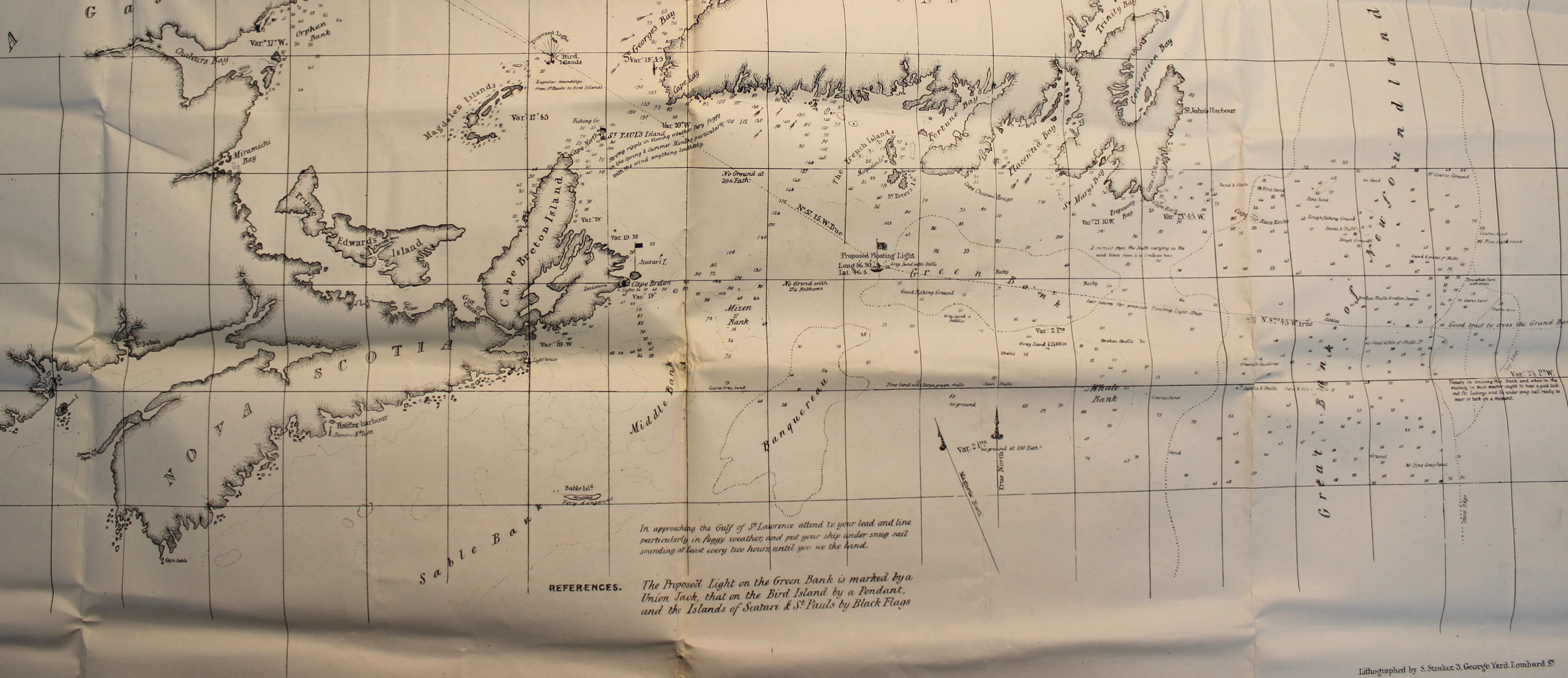
Navigational hazards and environmental dangers that were faced by those onboard ships while transiting from the Atlantic to the Gulf and their corresponding threats to human life had been widely recognized as early as 1825.[9] Members of the regional Houses of Assembly that legislated for colonies with access to the Gulf of St. Lawrence, moreover, were familiar with the challenges and opportunities that came with the responsibility to provide land for a growing number of settlers. Their experiences are in part captured by scholars such as Angela Tozer who has traced the violence that settler colonial land policies inflicted upon Indigenous people and the landscape in Epekwitk (Prince Edward Island).[10] John Reid and Elizabeth Mancke have explored the political upheaval that this period entailed for the region, and scholars such as John Belich and Cole Harris have analyzed these waves of immigration using global and regional lenses respectively.[11] The very subjects of the histories studied by these scholars involve the movement of people from one place to another, and in many cases one or more transits across the Atlantic Ocean. The movement, settlement, and violence associated with this large influx of peoples from the British Isles was not limited to the terrestrial spaces which have been the stages for many of these histories. Between 1820 and 1839 all settlers who arrived in the Canadas, Prince Edward Island, and the Gulf communities of New Brunswick and Nova Scotia did so onboard a ship which transited through the Gulf, and in the process they were transformed by the emotive and imaginative power of the Gulf of St. Lawrence.[12] Navigational hazards and threats posed by the natural world drove these responses, while their echoes crossed the Atlantic in the form of reported loss of human life and vessel losses, they did not only endanger the merchant marine. The severity of the navigational hazards in the Gulf of St. Lawrence were presented to the British Admiralty in 1827 by Captain Henry W. Bayfield who recognized, along with Buchanan, the life-threatening risks taken by those who navigated the Gulf and River Saint Lawrence.[13]
While there is no evidence to suggest that Buchanan was informed about the debates going on to construct lighthouses at the entrance to the Gulf of St. Lawrence, it is clear that he was driven by the loss of human life in the Gulf to present his imagined solutions to Lord Aylmer—knowing that they might not be adopted—in hope of seeing fewer of his fellow humans meet their demise in the waters of the Gulf, or along its jagged rocky coastlines. It would take another four and a half years after the mailing of Buchanan’s letter in 1835 for the lighthouses at St. Paul’s Island and Scatarie Island to be constructed. Buchanan’s chart is indicative of the way that physical environments such as the Gulf were spaces that were being imagined and re-imagined in response to changes in immigration that, in turn, increased the risk of navigating safely in that marine environment. Much more work needs to be done to provide a more nuanced understanding of navigational safety in the Gulf and just what, and who, was at stake. How people felt, imagined, and responded to these threats and one another, will be key to doing this work, which looks to build upon the important research on the history of imagination and emotion being carried out by Jack Bouchard and Keith Grant, respectively.[14]
Zachary A. Tingley is a PhD Candidate in History with the department of History and Politics at the University of New Brunswick, Saint John, where he is being co-supervised by Drs. Erin Spinney (UNBSJ) and Joshua MacFadyen (UPEI). His SSHRC funded dissertation project, titled “Navigating a Marine Commons: The Gulf of St. Lawrence and the Challenges of Maritime Safety, 1815-1867”, explores the intersections of governance, marine navigation, and the environment to historicize institutional and individual responses to real, and imagined, threats to human life in the Gulf during the nineteenth century. Zachary is a collaborator with the SSHRC-funded project, “Ecologies, Knowledge, and Power in the Gulf of St. Lawrence Region, c.1500-present.” For more about this project, see this overview at NiCHE, and for other posts at Acadiensis, Borealia, or NiCHE related to this project, see https://atlanticdigitalscholarship.ca/ongoing-projects/the-gulf-project/.
[1] Alexander Carlisle Buchanan, “The Following Is a Copy of a Letter That Mr. Buchanan Addressed to Lord Aylmer in Relation to Suggested Improvements in the Navigation of the Gulf of St. Lawrence and Sea Adjacent,” August 1, 1835, https://www.canadiana.ca/view/oocihm.21490/6.
[2] Buchanan.”
[3] The Gulf of St. Lawrence is approximately 236,000 square kilometers in size.
[4] Buchanan, “Suggested Improvements in the Navigation of the Gulf of St. Lawrence and Sea Adjacent.”
[5] Buchanan, “Suggested Improvements in the Navigation of the Gulf of St. Lawrence and Sea Adjacent.”
[6] Buchanan, “Suggested Improvements in the Navigation of the Gulf of St. Lawrence and Sea Adjacent.”
[7] John C. Weaver, James De Jonge, and Darrell Norris, “Transatlantic Migrations, 1831-1851,” in Historical Atlas of Canada: The Land Transformed, 1800-1891, ed. R. Louis Gentilcore, Don Measner, and Ronald H. Walder, vol. II (Toronto: University of Toronto Press, 1993), Plate 9.
[8]For further discussion on the actors involved in discussing navigational safety in the region see: Zachary A. Tingley and Elizabeth Mancke, “Intercolonial Cooperation and the Building of St. Paul Island and Scatarie Island Lighthouses, 1826-1840,” Acadiensis: Journal of the History of the Atlantic Region / Revue d’histoire de La Region Atlantique 51, no. 2 (September 2022): 60–90.
[9] Tingley and Mancke.
[10] Angela Tozer, “Racial Capital, Public Debt, and the Appropriation of Epekwitk, 1853–1873,” Journal of Canadian Studies 57, no. 2 (August 1, 2023): 233–54.
[11] John G. Reid, “Immigration to Atlantic Canada: Historical Reflections,” Journal of the Royal Nova Scotia Historical Society 19 (September 2016): 38–53; John G. Reid, “Scots, Settler Colonization and Indigenous Displacement: Mi’kma’ki, 1770–1820, in Comparative Context,” Journal of Scottish Historical Studies 38, no. 1 (May 2018): 178–96; Elizabeth Mancke, “Spaces of Power in the Early Modern Northeast,” in New England and the Maritime Provinces: Connections and Comparisons, ed. John G. Reid and Stephen J Hornsby (Montreal and Kingston: McGill-Queen’s University Press, 2005), 32–49; Elizabeth Mancke, “The Age of Constitutionalism and the New Political History,” Canadian Historical Review 100, no. 4 (December 2019): 620–37; James Belich, Replenishing the Earth: The Settler Revolution and the Rise of the Anglo-World, 1783-1939 (Oxford: Oxford University Press, 2009); Cole Harris, The Reluctant Land: Society, Space, and Environment in Canada before Confederation (Vancouver: UBC Press, 2008); Cole Harris, “The Spaces of Early Canada,” Canadian Historical Review 91, no. 4 (December 2010): 725–59.
[12] Claire Campbell, George Macdonald, and Brian Payne have demonstrated the importance of the Gulf of St. Lawrence as a watery backdrop for our shared human past in Claire Elizabeth Campbell, George Edward MacDonald, and Brian J. Payne, eds., The Greater Gulf: Essays on the Environmental History of the Gulf of St. Lawrence, McGill-Queen’s Rural, Wildland, and Resource Studies Series 6 (Montreal and Kingston: McGill-Queen’s University Press, 2019).
[13] Ruth Mackenzie, “Introduction,” in The St. Lawrence Survey Journals of Captain Henry Wolsey Bayfield, 1829-1853, ed. Ruth McKenzie, vol. 1 (Toronto: The Champlain Society, 1984), xxviii.
[14] Jack Bouchard, “Litus Ignotus: Lost Coasts of Terra Nova in the Sixteenth Century,” Coastal Studies & Society 2, no. 1 (March 2023): 14–37; Keith S. Grant, Enthusiasms and Loyalties: The Public History of Private Feelings in the Enlightenment Atlantic, McGill-Queen’s Studies in Early Canada / Avant Le Canada 6 (Montreal and Kingston: McGill-Queen’s University Press, 2022).


Latest Comments